 18+
18+
18+
18+
A ~97% RTP, high volatility, and crash mechanics that reward timing over luck — here is everything that shapes your real session outcomes.
Free demo — no real money. Mirrors the real game's behaviour. May be unavailable in some regions.
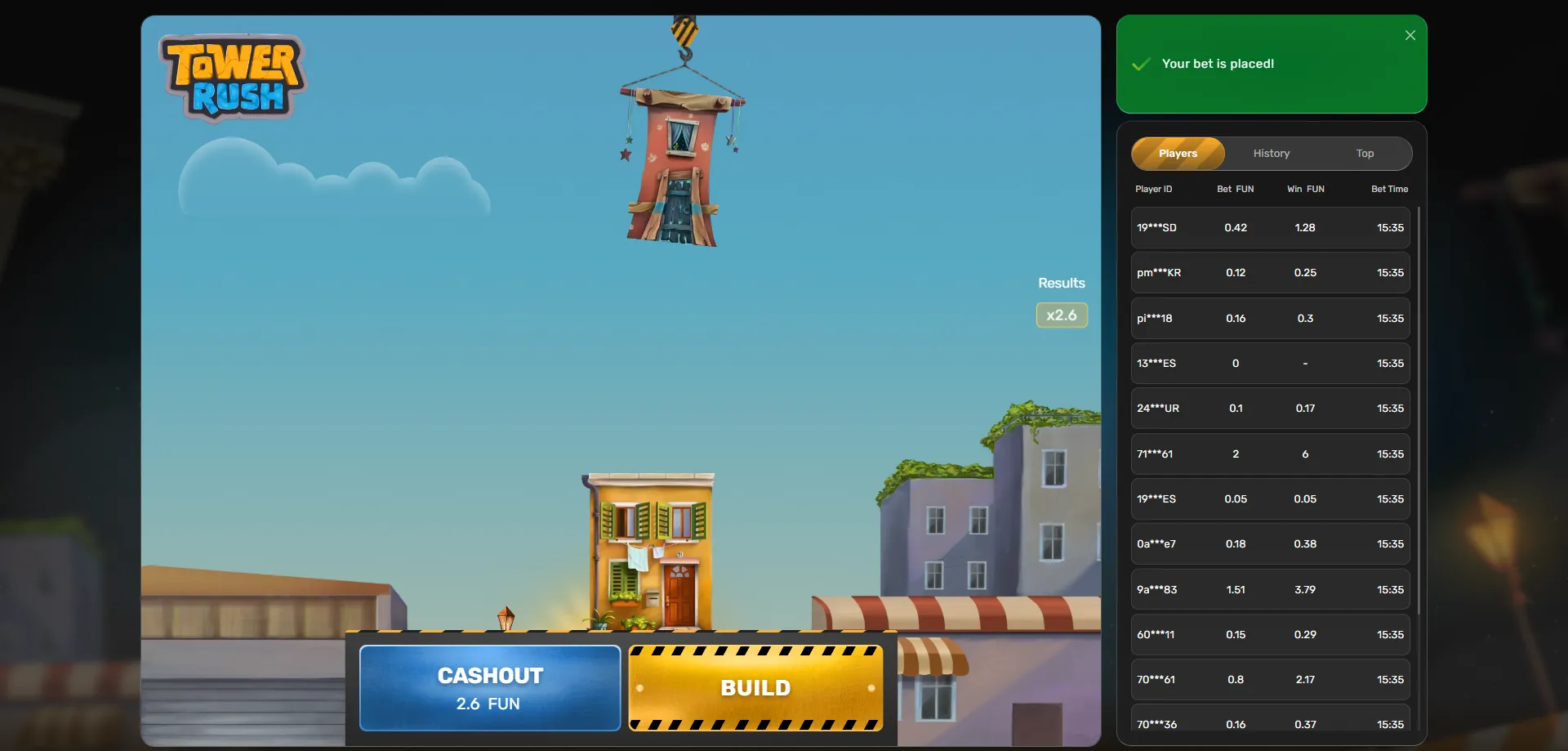
Before you place a single rupee on Tower Rush, two numbers will shape every session you ever play: the return-to-player (RTP) percentage and the volatility rating. Most players skip straight past them and wonder later why their bankroll behaved nothing like they expected. Understanding what these figures actually mean — and, crucially, what they do not mean — is the single most practical thing you can do before opening the game.
Tower Rush is a crash-format title developed by Galaxsys. It operates on a rising multiplier that climbs as a virtual tower builds in real time. There are no reels, no paylines, and no scatter combinations — just you, a cash-out button, and a published tower rush rtp of approximately 97%. That figure places it well above the industry average for online casino games, but the high volatility rating means the experience in any single session can feel wildly different from what a percentage on a spec sheet suggests.
RTP is a theoretical, long-run statistical measure. Galaxsys has set Tower Rush's figure at approximately 97%, though the exact value can vary marginally depending on which licensed operator is hosting the game. What this means in plain terms: across millions of rounds, the game is designed to return around ₹97 for every ₹100 wagered in aggregate. The operative word is aggregate — spread across an enormous sample of players and rounds, not across your personal Tuesday evening session.
The figure is calculated by Galaxsys using a certified random number generator (RNG) and independently tested by third-party auditors. It is not a promise of individual performance. It is a distribution statement about a population of outcomes. That distinction matters enormously when you are managing a fixed session budget on your phone during a commute.
Volatility describes the pattern of how a game distributes its payouts over time. Tower Rush carries a high volatility rating. In practical terms, this means the game tends to cluster outcomes — you may experience several consecutive early crashes that cost your full stake, followed by a round where the multiplier climbs to 10× or higher before collapsing. The wins, when they arrive, can be disproportionately large relative to your stake. The gaps between them can be equally long.
Thinking of volatility as rhythm rather than risk reframes how you plan a session. A low-volatility game taps out a steady beat — small, frequent returns that keep your balance fairly stable. A high-volatility game like Tower Rush plays in irregular bursts — long silences punctuated by loud peaks. Neither rhythm is inherently better; they suit different player types and different bankroll sizes.
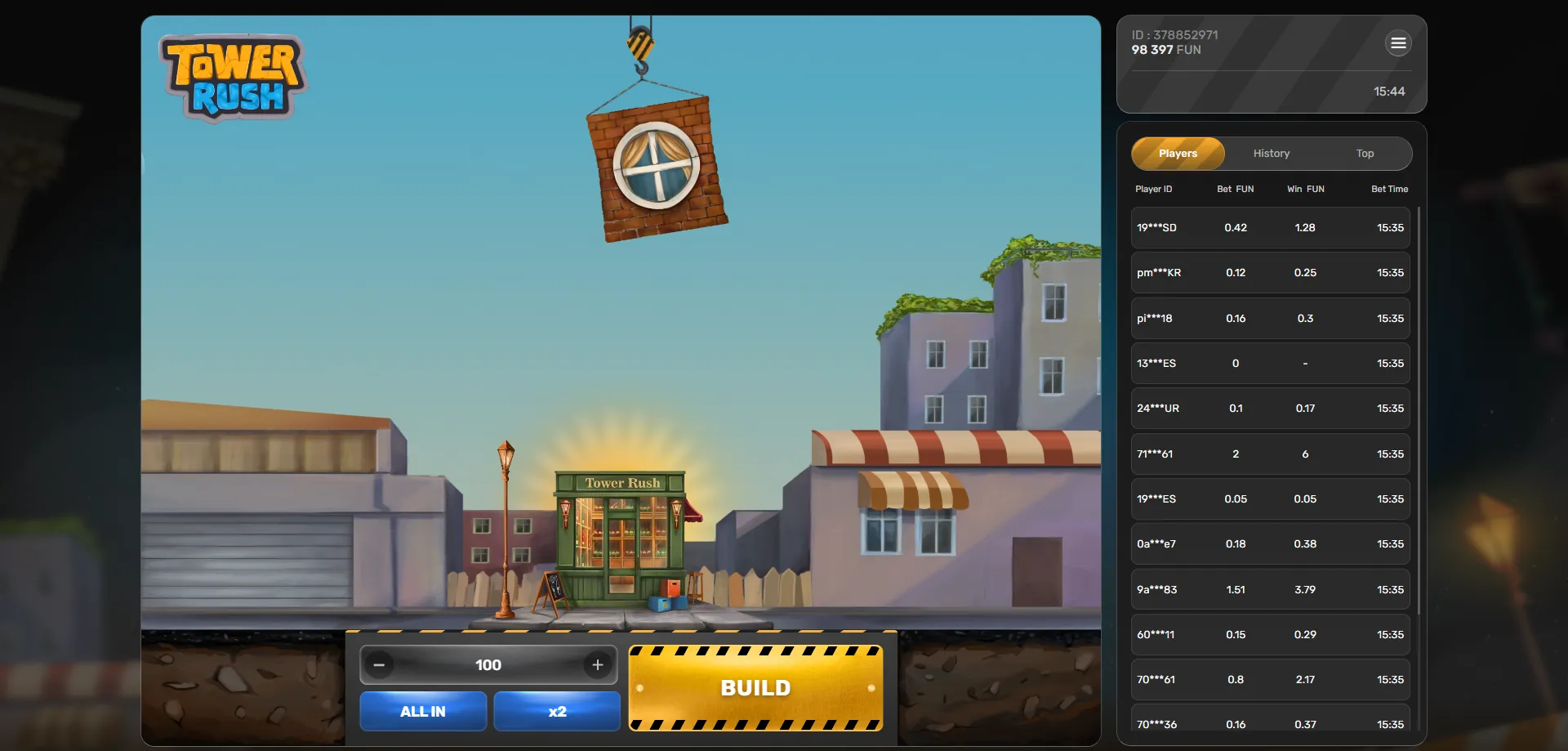
A common misconception is that RTP is calculated per session or even per hundred rounds. It is not. The 97% figure for Tower Rush is derived from a simulation of tens of millions of rounds. The law of large numbers ensures that, at sufficient scale, the game's outcome distribution converges toward that theoretical percentage. Your personal sample — say, 200 rounds in a single evening — is statistically microscopic. The variance around the theoretical mean at that sample size is enormous.
In a session of 50 to 200 rounds, your actual return could be anywhere from 0% to several multiples of your starting balance. Both extremes are mathematically possible and neither contradicts the published 97% RTP. What the RTP number tells you is that, over a long enough horizon, the game is designed to be less unfavorable than most slot machines on the market — not that any given session will reflect that fairness.
Tower Rush also uses a provably fair system, which allows players to independently verify the crash point of each completed round using cryptographic seeds. This is a meaningful additional layer of transparency: you can confirm after the fact that no round's outcome was altered after your bet was placed. That is distinct from — and more powerful than — an RTP figure alone.
Suppose you play 10 rounds at ₹100 each, staking ₹1,000 in total. A naive reading of 97% RTP would suggest you finish with ₹970. In reality, you might cash out on 6 rounds and lose 4, finishing with ₹1,150 — or you might miss your cash-out timing on 8 rounds and end the session with ₹200. Both outcomes are entirely consistent with a 97% theoretical RTP. The percentage describes a statistical attractor, not a session guarantee. The higher the volatility, the more dramatically individual sessions can deviate from that attractor.
While Tower Rush itself sits firmly in the high-volatility category, understanding all three volatility tiers helps you interpret its behavior in context — and helps you decide whether its rhythm matches your current bankroll and available playing time.
Low-volatility games pay out frequently but in smaller amounts. If you were playing a low-volatility crash game, you might expect the multiplier to collapse early in many rounds but occasionally climb modestly — and your balance would tick up and down in narrow bands. This suits players with small budgets who want extended playtime and minimal dramatic swings. Tower Rush is the opposite of this profile.
Medium-volatility games blend payout frequency with occasional larger wins. Sessions feel more varied than low-volatility play without the long dry spells of high-volatility titles. Many standard casino slots target this middle tier because it appeals to the broadest range of players. Tower Rush does not sit here either — its crash-format mechanics naturally push it toward higher variance.
This is Tower Rush's home tier. High-volatility crash gameplay means a meaningful share of rounds will end at the very bottom of the multiplier range — the tower collapses almost immediately. But when rounds extend, they can climb to multipliers that make a single well-timed cash-out worth many times what a low-volatility game would ever deliver in a comparable session. The risk management implication is direct: keep individual round stakes to 1%–3% of your session budget so that a losing streak does not end your session before a strong round arrives.
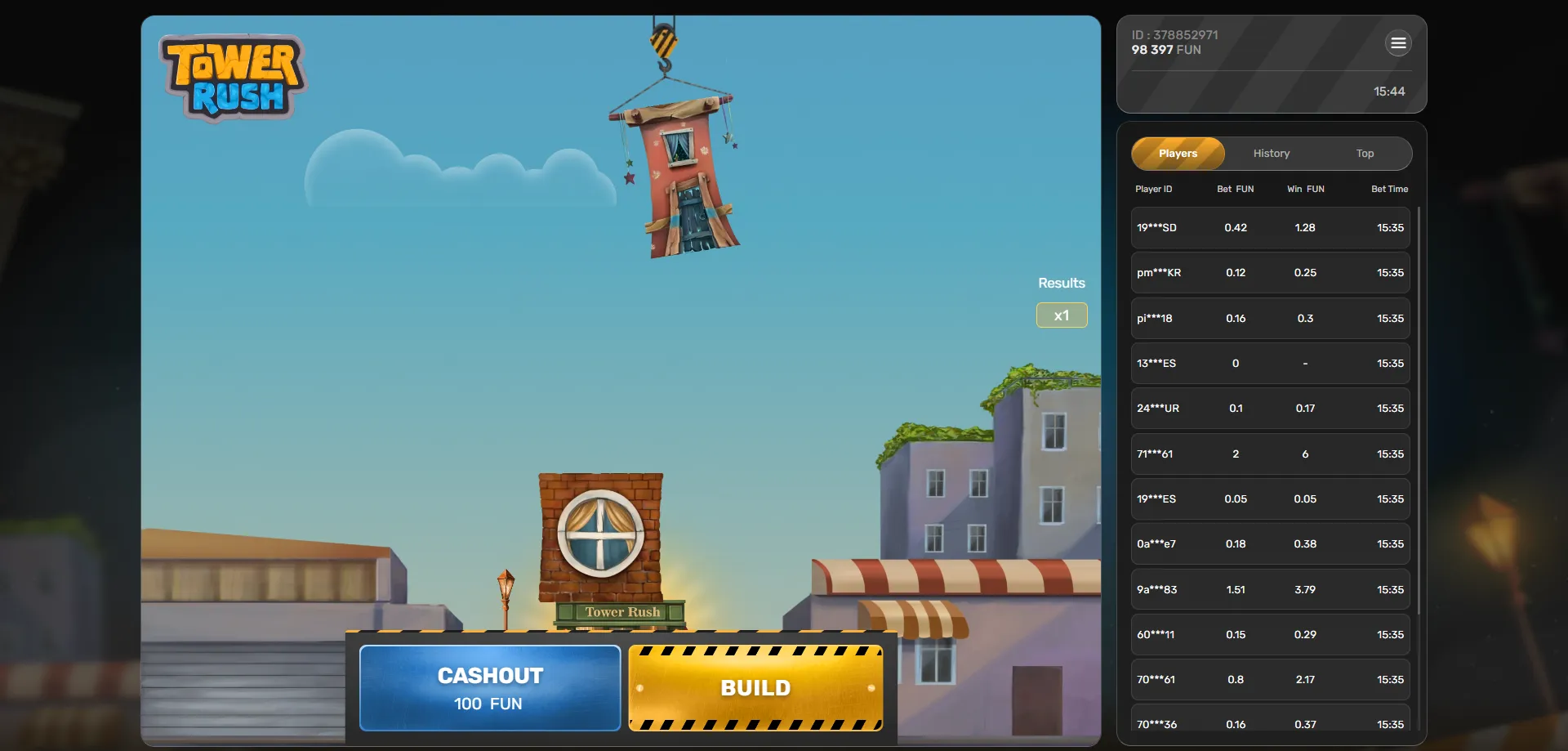
Choosing how to play Tower Rush is not just about understanding RTP and volatility in the abstract — it is about matching those numbers to your specific situation on any given session. The following matrix is a practical reference:
| Budget Size | Session Goal | Recommended Approach | Target Multiplier Range |
|---|---|---|---|
| Small (₹200–₹500) | Extended play, low pressure | Conservative cash-outs, auto exit on | 1.5× – 2× |
| Medium (₹500–₹2,000) | Balanced win potential | Mixed targets, manual and auto exits | 2× – 5× |
| Large (₹2,000+) | Chasing higher multipliers | Higher-variance targets, strict stop-loss | 5× – 20× |
The auto cash-out feature built into Tower Rush is particularly valuable for mobile players — it removes the psychological pressure of watching the multiplier climb and second-guessing your exit point while you are on the move. Set your threshold before the round begins and let the game execute it for you.
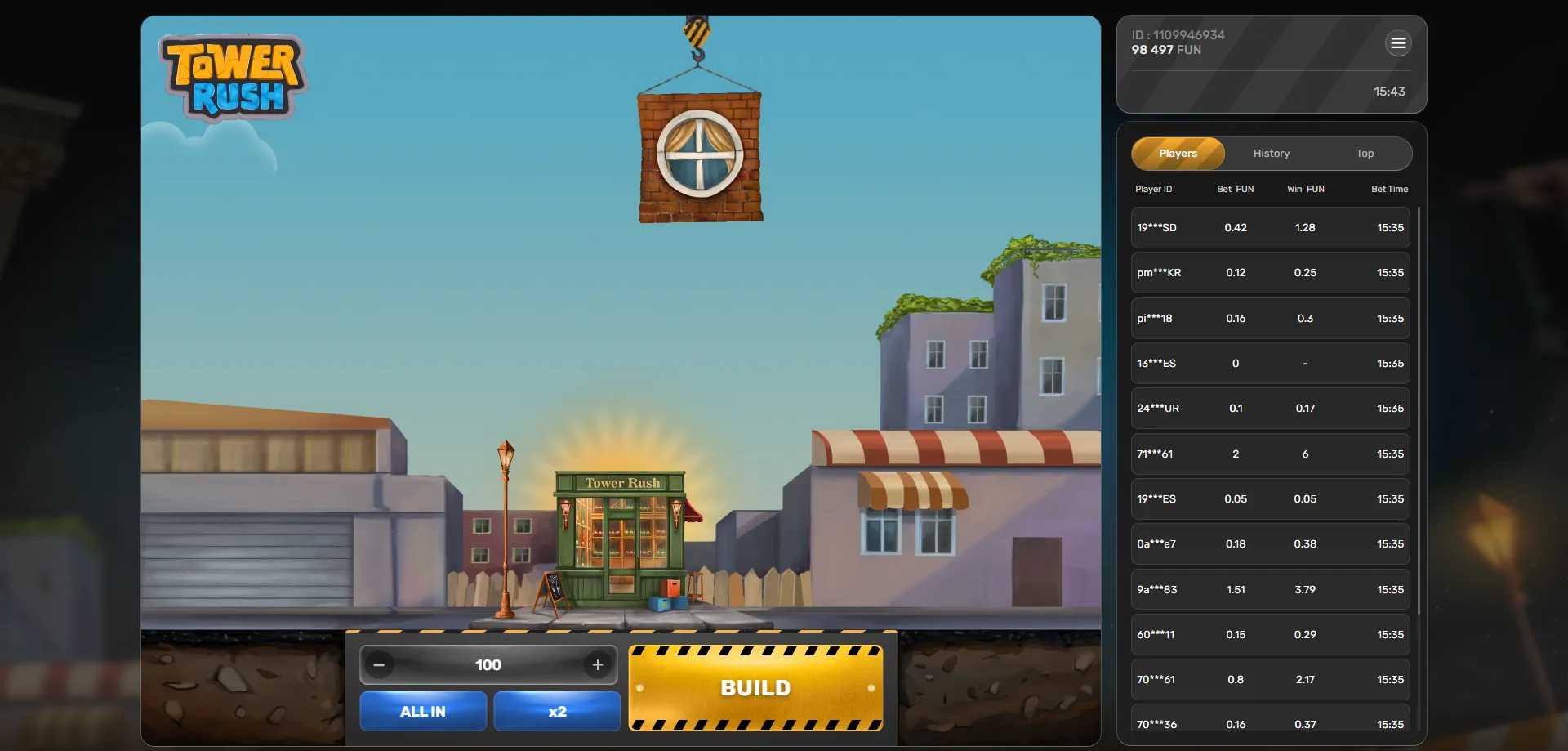
Tower Rush the crash game occupies a strong position in its own category at the casino platform of the same name. Its published ~97% RTP is genuinely competitive. For reference, the industry average across standard video slots hovers around 95%–96%, making Tower Rush's figure meaningfully above average — particularly notable given that most high-volatility games tend to offer slightly lower RTPs as a tradeoff for their elevated max-win potential.
Within the broader Tower Rush platform, Galaxsys titles — including the crash game itself — consistently rank among the higher-RTP options available. Galaxsys as a studio has built its reputation on transparent, provably fair mechanics, which naturally aligns with above-average published return rates. When browsing other titles in the catalogue, look for the RTP figure in the game's information panel before starting; anything at or above 96.5% is a solid benchmark for value.
Crash and multiplier-format games like Tower Rush require a different evaluative lens than traditional slots. Because there is no fixed paytable or symbol combination system, the RTP interacts with your individual cash-out decisions in a way that no slot game does. A player who always exits at 1.2× will experience a different effective return rate than one targeting 10×, even though both are playing the same title with the same published RTP. Your strategy becomes part of the equation in a way that is simply not true for passive reel-spinning games.
Tower Rush does not feature traditional bonus rounds or free spin mechanics triggered by scatter symbols. Instead, it has three unique Bonus Floors — Frozen Floor, Temple Floor, and Triple Build — that are triggered entirely at random by the game's certified RNG. You cannot purchase access to these features; there is no Bonus Buy option.
The high volatility of the base game extends directly into these bonus floor events. Because they are randomly triggered rather than purchased or reliably activated, their frequency of appearance is itself subject to the same variance that governs the rest of the game. During a dry streak, you may play dozens of rounds without seeing a special floor. During a hot run, they may appear in clusters. This is not a flaw — it is a structural consequence of the high-volatility design. Players who understand this ahead of time are less likely to make impulsive stake increases while waiting for a feature to trigger.
The Frozen Floor mechanic in particular is notable because it provides a temporary safety net — a floor below which the multiplier cannot collapse. Players report that this feature meaningfully changes the risk calculus for the round in which it appears. Timing your cash-out during a Frozen Floor event is one of the clearest strategic decisions the game offers.
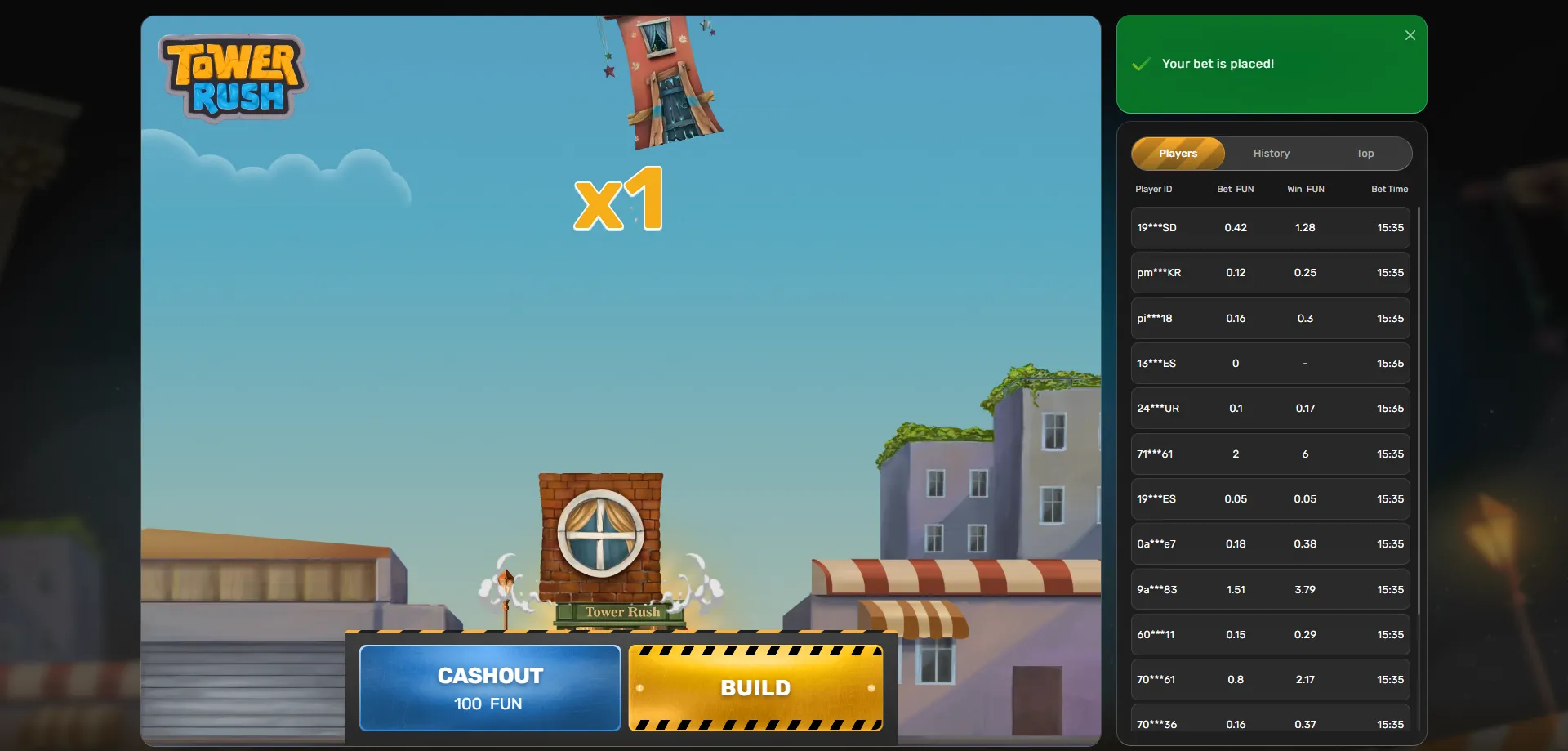
A persistent question among new players is whether the Tower Rush demo mode operates on the same RTP as the real-money version. The short answer is: the underlying game engine and RNG are identical. The demo simply substitutes virtual credits for real currency. Galaxsys does not publish separate RTP figures for demo and real-money modes because the algorithmic behavior is the same in both environments.
What this means practically is that the demo is a genuinely useful tool for calibrating your cash-out timing and understanding the volatility rhythm before committing real funds. You can test whether a 2× auto cash-out strategy feels sustainable over 100 rounds, or whether you want to experiment with a more aggressive 5× target — all without financial exposure. Some casinos allow instant demo access without registration; others require a logged-in account. Either way, the data you gather in demo mode reflects the same statistical distribution you will encounter in real-money play.
One caveat worth noting: the psychological experience of watching real money rise and fall is genuinely different from managing virtual credits. Demo testing builds mechanical familiarity; it does not fully replicate the decision-making pressure of a live real-money session. Use it to learn the game, not to predict your emotional responses to it.
Before you open Tower Rush on your phone — whether you are five minutes into a commute or settling in for a longer session — run through the following checklist. It takes less than two minutes and it will materially change how consistently you manage your bankroll against a high-volatility game.
If you want to go deeper on strategy before your first real-money session, the Tower Rush Strategy – Tips and Tricks to Win page covers bankroll frameworks in more detail. For a complete breakdown of how the mechanics work, the Tower Rush Rules – How the Game Works guide is the clearest reference. And if you are still weighing whether the platform is right for you, the Tower Rush Review – Is It Legit? covers licensing, payment options, and player experience in full.
Register an account today at ugwapk.com and get an exclusive bonus boost to start your climb to the top of the Tower Rush leaderboard!
🚀 Play Tower Rush🔒 18+ · T&C Apply · Play Responsibly